South China University of Technology · Guangzhou International Campus
D1
Research direction 01 · diagnosis and prognostics

Mechanism-Interpretable Fault Diagnosis and Health Management

We convert heterogeneous engineering measurements into physically meaningful fault evidence, mechanism-consistent explanations, and credible health decisions under variable operating conditions.

Interpretable fault diagnosisPrognostics and health managementCausal fault tracingPhysics-informed learningDomain generalisation
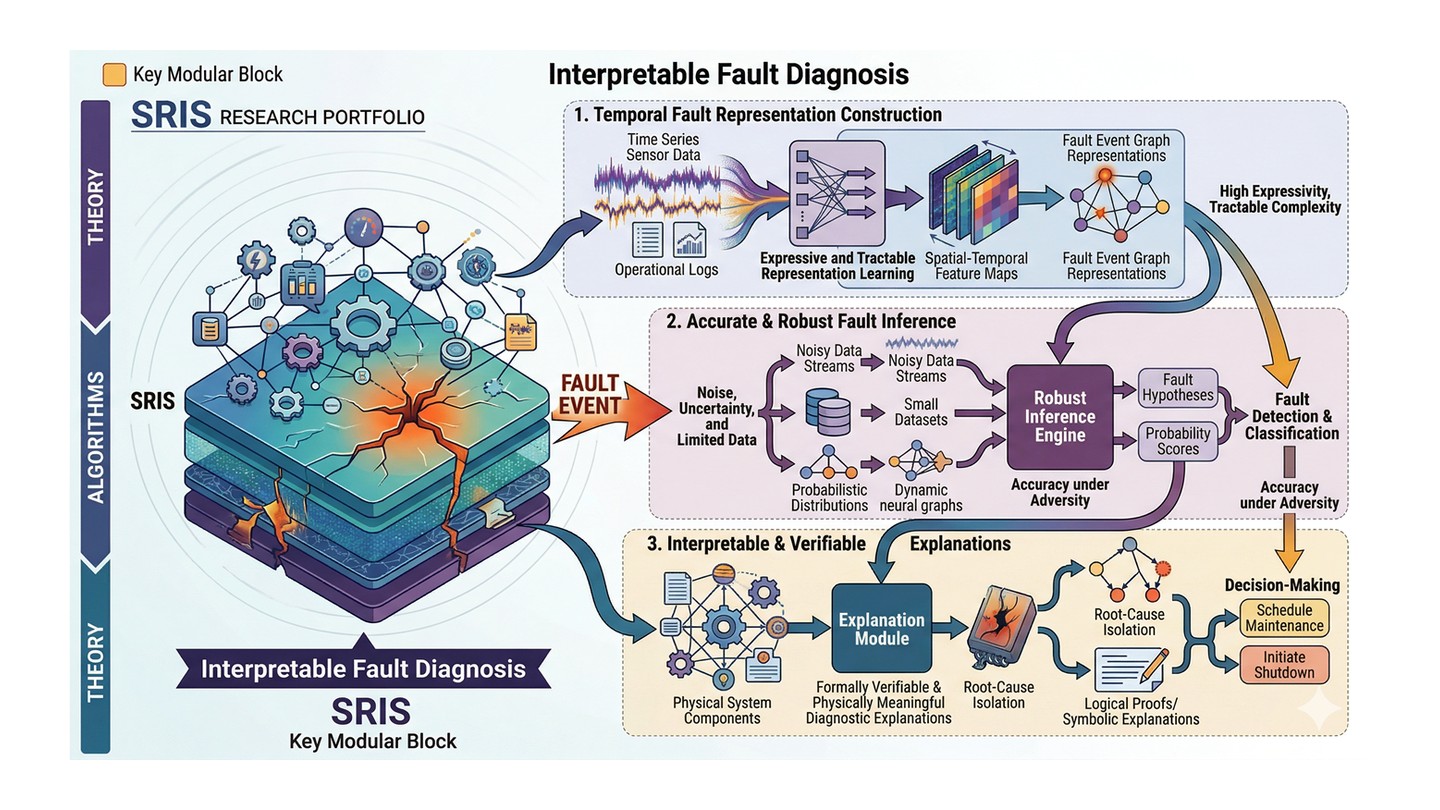
Research framework for mechanism-interpretable fault diagnosis
Direction-level concept figure. It consolidates signal evidence, mechanism modelling, interpretable inference, and health decisions; the file can be replaced later without changing the page structure.
Direction overview

From measured symptoms to defensible engineering decisions

This direction treats diagnosis as an evidence-construction problem rather than a closed-set classification task. Signal processing, physical models, causal structures, and uncertainty descriptions are designed together so that a conclusion can be traced back to measurable phenomena.

Research covers rotating machinery, multistage transmissions, manufacturing processes, and other condition-monitoring systems in which faults evolve across components, operating regimes, and sensing modalities.

Key scientific questions

Three questions that define the direction

01

How can invariant fault evidence be recovered from nonstationary measurements?

Speed, load, sensor position, noise, and structural transfer paths alter the observed waveform. The challenge is to retain fault order, modulation, recurrence, propagation, and degradation information while separating operating-condition variation from mechanism-related structure.

02

How can local symptoms be connected to mechanisms and root causes?

Reliable diagnosis must explain how evidence propagates through components and subsystems. We combine physical priors, digital twins, event and causal graphs, transfer-path analysis, and temporal logic to distinguish correlation from mechanism-consistent explanation.

03

When should a diagnostic conclusion be trusted and acted upon?

Models must remain useful with limited labels, unseen domains, compound faults, and uncertain evidence. We study calibrated uncertainty, cross-domain invariance, verifiable explanations, and decision interfaces for maintenance, isolation, and fault-tolerant operation.

Theory · Methods · Software

From research questions to a working system

Explore our research methods and digital-twin software in a 20-slide presentation, with a Chinese-subtitled demonstration on slide 19.

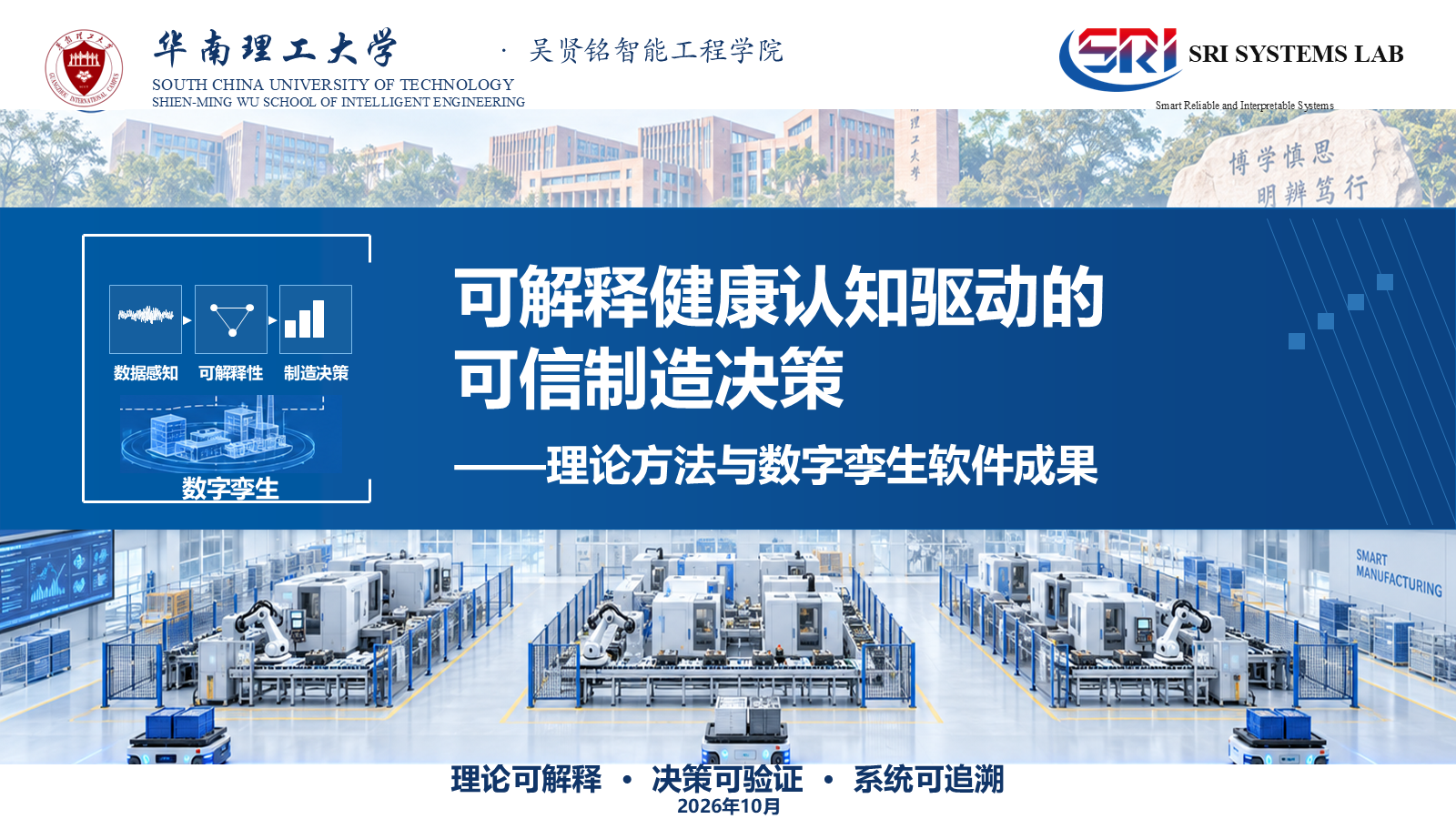
理论与软件成果可解释健康认知驱动的可信制造决策
第1页:可解释健康认知驱动的可信制造决策,理论方法与数字孪生软件成果
SRIS LABORATORY

选择演示页面

网页演示保留PPT实际渲染的图表、排版与渐变;原始PPT中的文字、图表和框架仍可编辑。视频为离线软件演示,不代表现场执行。

Research framework

From scientific object to engineering outcome

01

Engineering evidence

Vibration, current, force, images, operational logs, and physical models

02

Mechanism-aware representation

Orders, time-frequency structures, events, causal graphs, and transfer paths

03

Robust interpretable inference

Domain generalisation, uncertainty reasoning, logic rules, and causal attribution

04

Health decision

Fault identification, root-cause isolation, maintenance planning, and risk-aware action

Publication portfolio

Related publications

—tagged publications
Loading publication data…