
South China University of Technology · Guangzhou International Campus
D2
Research direction 02 · learning and semantics

Neuro-Symbolic Learning and Formal Reasoning

We learn explicit temporal, causal, and logical structures from data so that model decisions can be interpreted, checked, revised, and reused as formal knowledge.

Signal temporal logicNeuro-symbolic learningCausal and event graphsRequirement miningFormal explanation
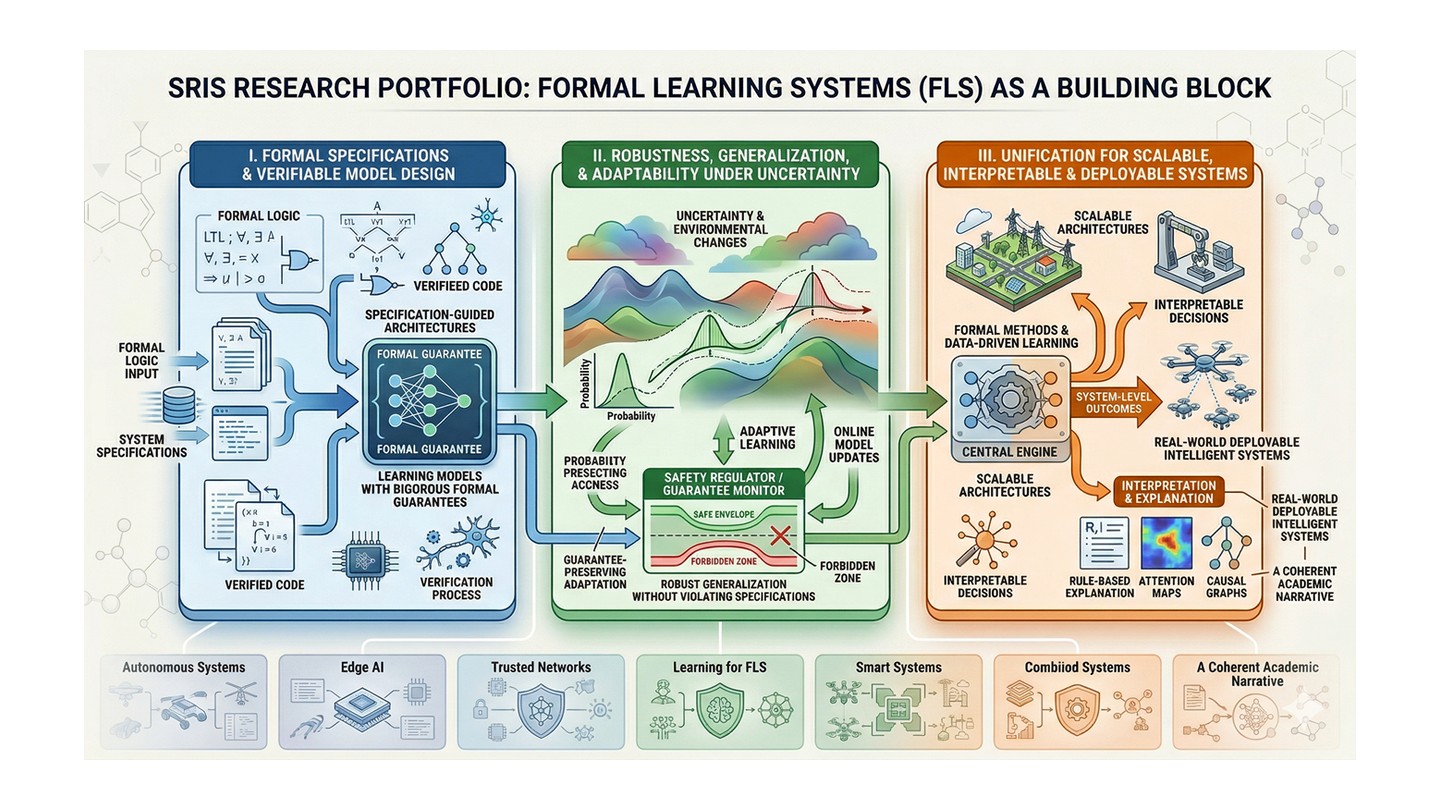
Research framework for formal learning and neuro-symbolic reasoning
Direction-level concept figure. It connects data-driven representation, explicit temporal or causal structure, formal semantics, and verifiable reasoning; the file can be replaced later without changing the page structure.
Direction overview

Learning representations that carry semantics—not only predictions

This direction connects neural representation learning with signal temporal logic, event and causal graphs, formal languages, and human knowledge. Explanation is not appended after prediction; symbolic structure is embedded in the model and optimisation problem.

The resulting representations support classification, requirement mining, semantic interpretation, verification, diagnosis, and controller synthesis across cyber-physical and industrial systems.

Key scientific questions

Three questions that define the direction

01

How can discrete symbolic structure and continuous parameters be learned jointly?

Temporal formulas, causal graphs, event structures, and program-like representations combine discrete topology with thresholds, time intervals, and weights. We study differentiable, sparse, structured, and search-based methods that optimise both without erasing semantics.

02

How can learned symbols be grounded in physical and temporal evidence?

A symbol is useful only when it corresponds to observable evidence and supports consistent reasoning. We study mechanism-anchored predicates, monotone and causal structures, formal-language constraints, and human-in-the-loop refinement.

03

How can formal knowledge remain valid under uncertainty and distribution shift?

Noise, incomplete labels, uncertain dynamics, and domain changes can invalidate brittle rules. We develop robust semantics, uncertainty-aware inference, abstraction refinement, and verification interfaces that make the validity boundary explicit.

Research framework

From scientific object to engineering outcome

01

Data and prior knowledge

Time series, events, demonstrations, physical constraints, and expert concepts

02

Structured learning

Sparse attention, differentiable logic, causal graph learning, and system abstraction

03

Formal representation

Temporal formulas, event graphs, specifications, rules, and contracts

04

Reasoning and verification

Explanation, requirement mining, semantic classification, and reusable guarantees

Publication portfolio

Related publications

—tagged publications
Loading publication data…