South China University of Technology · Guangzhou International Campus
Three research directions

Research organised by scientific questions

The laboratory programme is organised into three coherent directions. Each direction has a distinct scientific object, three central research questions, a dedicated page, and a publication portfolio linked through shared direction tags.

Diagnosis · Reasoning · Control Three directions connected by a common evidence–semantics–action pipeline.
Research directions

Three coherent research directions

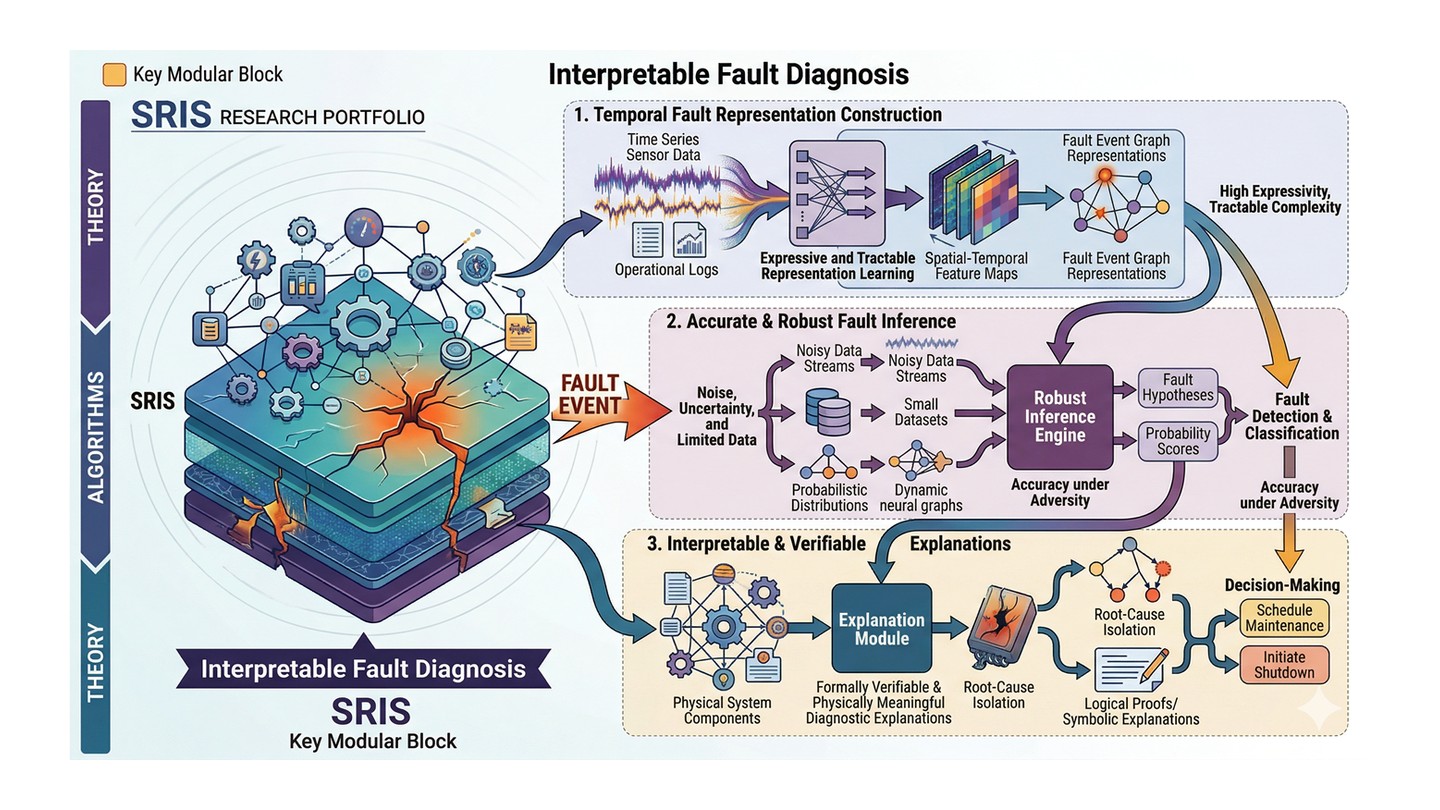
Research framework for mechanism-interpretable fault diagnosis D1
D1 — related publications

Mechanism-Interpretable Fault Diagnosis and Health Management

We convert heterogeneous engineering measurements into physically meaningful fault evidence, mechanism-consistent explanations, and credible health decisions under variable operating conditions.

  1. 01How can invariant fault evidence be recovered from nonstationary measurements?
  2. 02How can local symptoms be connected to mechanisms and root causes?
  3. 03When should a diagnostic conclusion be trusted and acted upon?
Explore direction
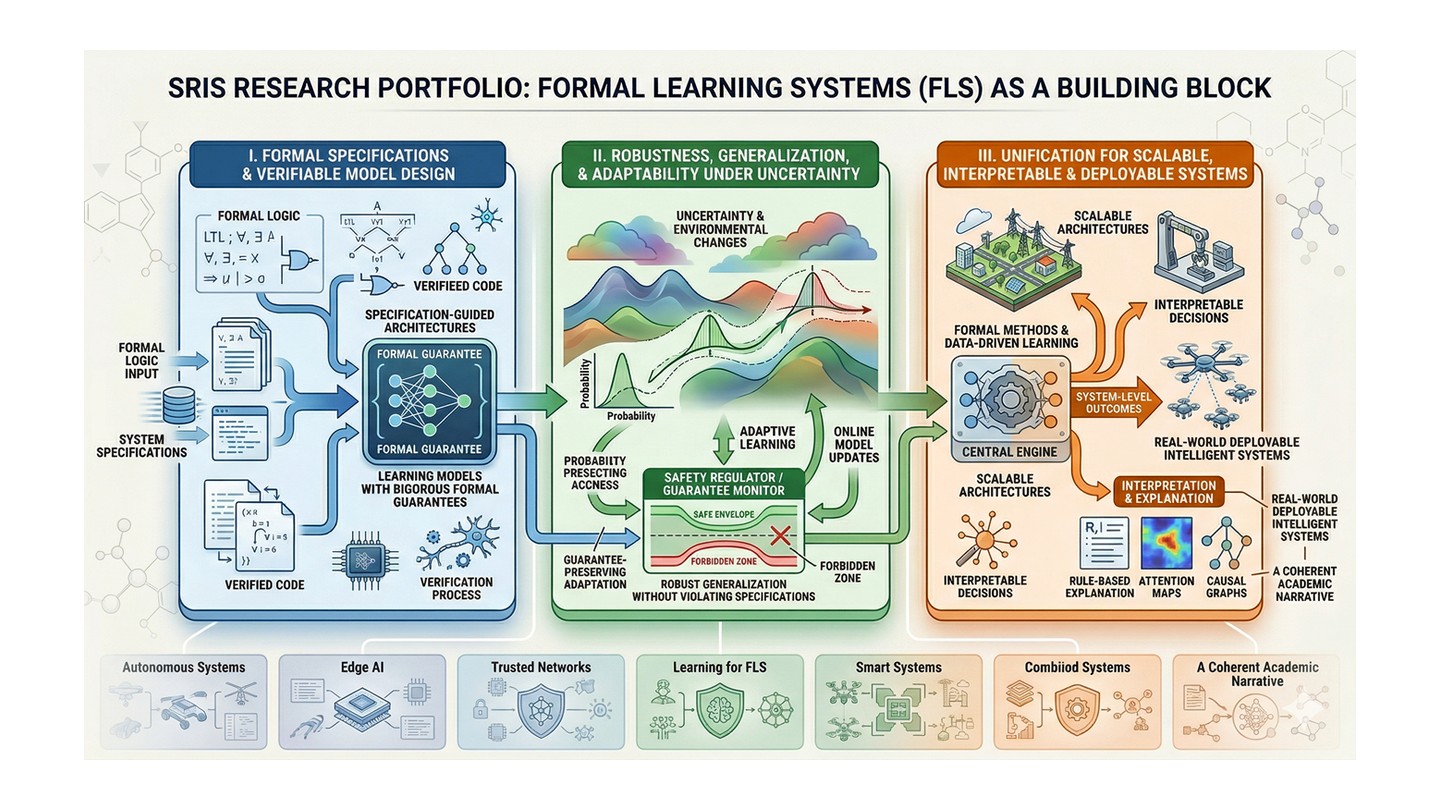
Research framework for formal learning and neuro-symbolic reasoning D2
D2 — related publications

Neuro-Symbolic Learning and Formal Reasoning

We learn explicit temporal, causal, and logical structures from data so that model decisions can be interpreted, checked, revised, and reused as formal knowledge.

  1. 01How can discrete symbolic structure and continuous parameters be learned jointly?
  2. 02How can learned symbols be grounded in physical and temporal evidence?
  3. 03How can formal knowledge remain valid under uncertainty and distribution shift?
Explore direction
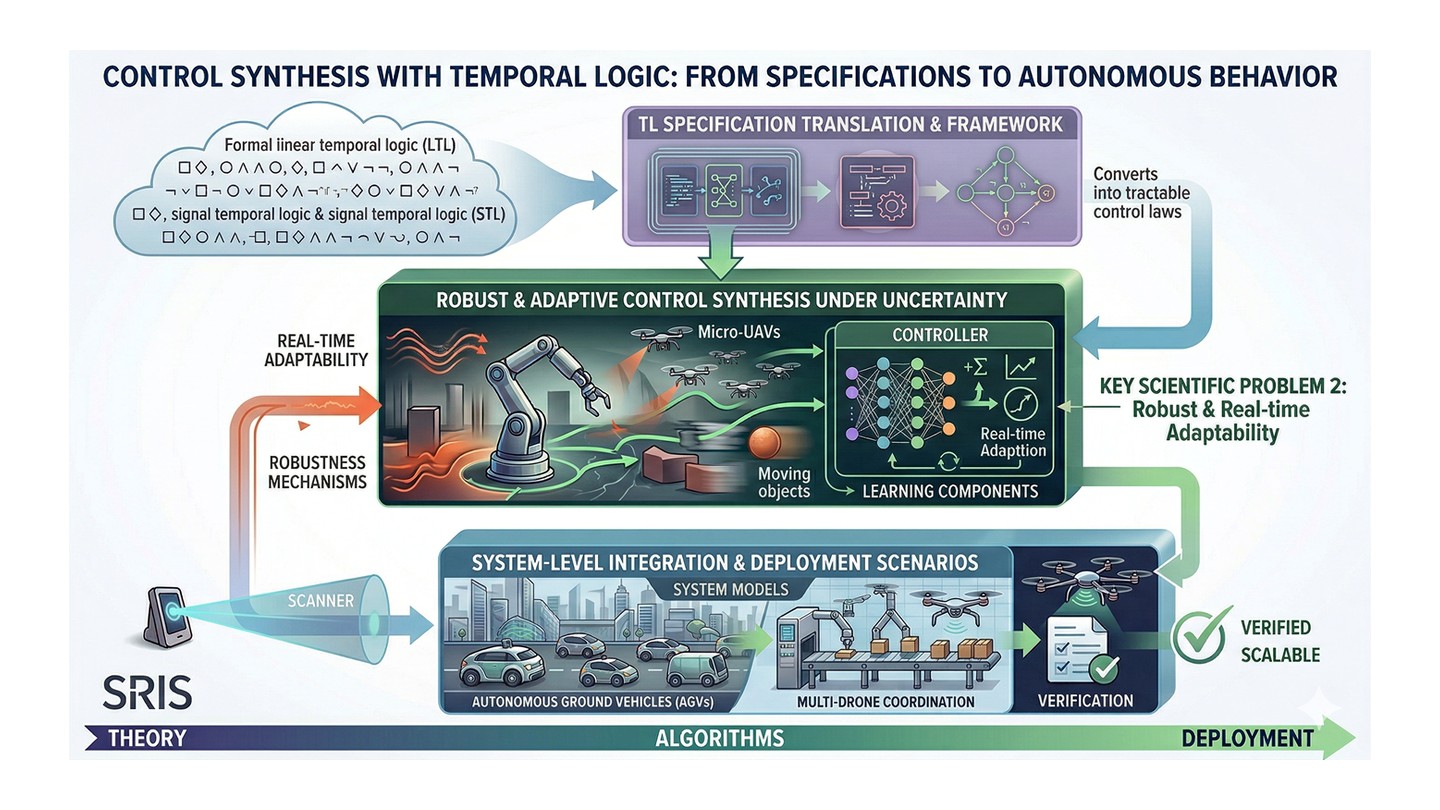
Research framework for temporal-logic-guided safe control D3
D3 — related publications

Safe Intelligent Control and Autonomous Systems

We develop learning-enhanced planning and feedback control methods that satisfy explicit temporal tasks, safety constraints, robustness requirements, and human-interaction objectives.

  1. 01How can temporal tasks and human intent be translated into feedback constraints?
  2. 02How can learning improve performance without violating safety and feasibility?
  3. 03How can autonomous decision-making scale to complex interactive systems?
Explore direction
Common research logic

Evidence, semantics, and action form one connected programme

01
EvidenceSignals, events, causal relations, and physical states
02
SemanticsFormulas, graphs, abstractions, explanations, and uncertainty
03
ActionDiagnosis, maintenance, planning, feedback, and fault tolerance
Funded projects

Research funding

Official project title Funding agency Period

外骨骼具身智能关键技术与应用

Department of Science and Technology of Guangdong Province

基于时序逻辑的协作机器人可解释“诊控”一体化方法研究

Guangdong Basic and Applied Basic Research Foundation Committee

基于时序逻辑的风电齿轮箱故障演化机理可解释定量表征方法研究

National Natural Science Foundation of China

海上风电机组传动链可解释故障诊断形式化定义、验证与推理

Guangdong Basic and Applied Basic Research Foundation Committee

制造大数据驱动的智能装备可解释故障诊断与形式化验证

Guangdong Basic and Applied Basic Research Foundation Committee

基于迁移学习的产线可解释故障诊断

Guangdong Basic and Applied Basic Research Foundation Committee

基于MEC的边缘控制与实时仿真基础理论与方法研究

Ministry of Science and Technology of the People’s Republic of China