
South China University of Technology · Guangzhou International Campus
D3
Research direction 03 · control and autonomy

Safe Intelligent Control and Autonomous Systems

We develop learning-enhanced planning and feedback control methods that satisfy explicit temporal tasks, safety constraints, robustness requirements, and human-interaction objectives.

Safe reinforcement learningSTL-guided controlCBF / CLF / MPCRobot learningFault-tolerant and discrete-event control
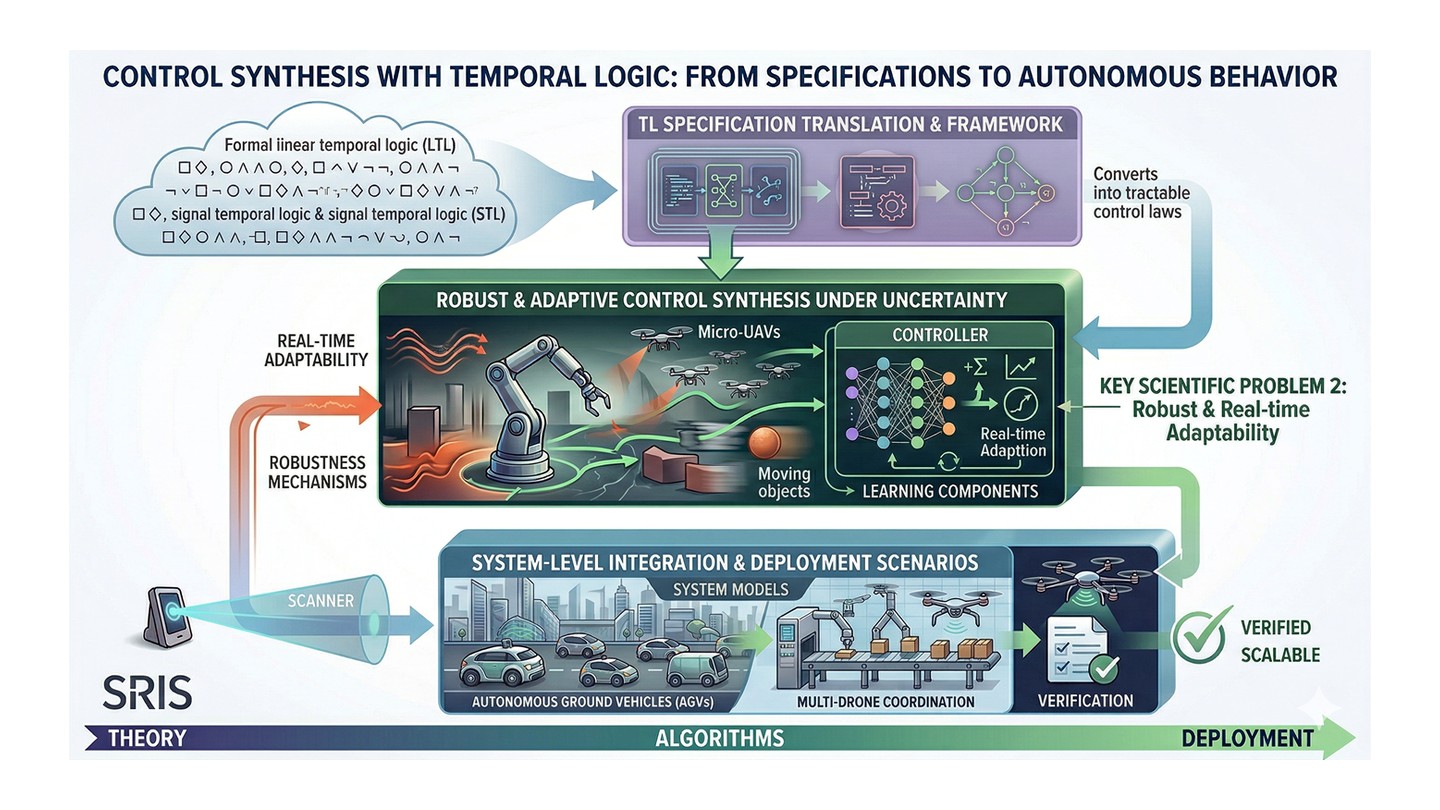
Research framework for temporal-logic-guided safe control
Direction-level concept figure. It links task specifications, feasibility and risk reasoning, planning or feedback synthesis, and verified autonomous behaviour; the file can be replaced later without changing the page structure.
Direction overview

From task specifications to safe, adaptive, and deployable behaviour

This direction integrates control theory, formal methods, optimisation, reinforcement learning, discrete-event synthesis, and robot learning. Safety and task satisfaction are treated as design constraints rather than post-deployment evaluation metrics.

Applications include nonlinear and hybrid systems, robotic manipulation, collaborative and wearable robots, manufacturing scheduling, fault-tolerant operation, and coordination of multiple autonomous platforms.

Key scientific questions

Three questions that define the direction

01

How can temporal tasks and human intent be translated into feedback constraints?

High-level requirements express ordering, deadlines, persistence, recovery, and interaction. We develop semantics and compilation methods that map these requirements into tractable optimisation, barrier-function, Lyapunov, automata, or model-predictive-control constraints.

02

How can learning improve performance without violating safety and feasibility?

Neural policies and reinforcement learning adapt well but may fail outside the training distribution. We combine learning with CLF/CBF filters, robust MPC, formal synthesis, recursive feasibility, and uncertainty adaptation so that improvement remains inside an explicit safety envelope.

03

How can autonomous decision-making scale to complex interactive systems?

Manipulation, scheduling, multi-agent coordination, and shared autonomy couple discrete decisions with continuous dynamics. We study hierarchical decomposition, graph reasoning, fault tolerance, real-time repair, and preservation of human agency.

Research framework

From scientific object to engineering outcome

01

Task and interaction model

Temporal specifications, human intent, dynamics, faults, and resource constraints

02

Feasibility and risk reasoning

Reachability, barrier margins, recursive feasibility, uncertainty sets, and event structure

03

Planning and feedback synthesis

MPC, CBF/CLF, reinforcement learning, formal and hierarchical control

04

Verified deployment

Safe motion, resilient operation, coordinated autonomy, and human-centred interaction

Publication portfolio

Related publications

—tagged publications
Loading publication data…